
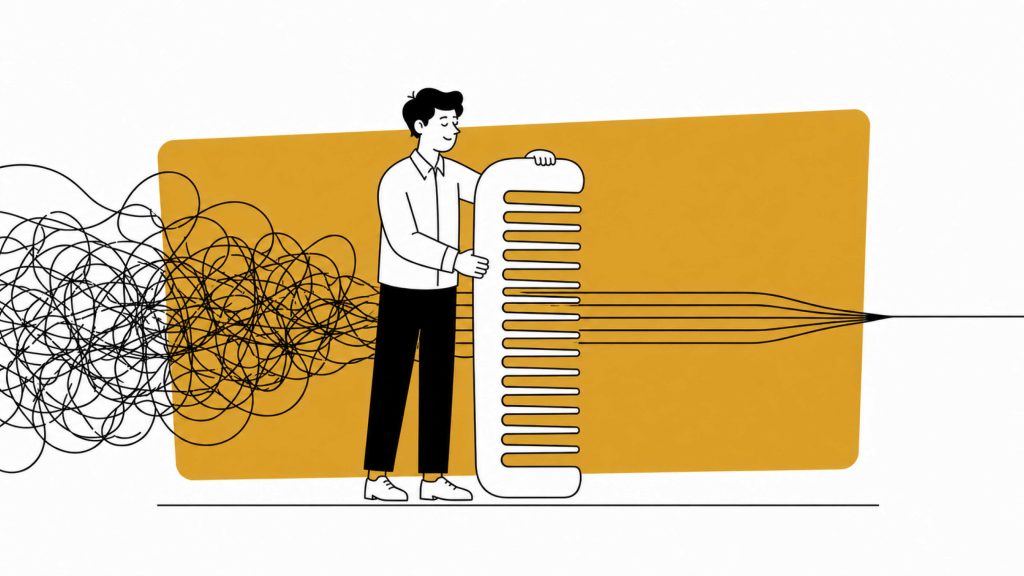
A strategy that does not change decisions is decoration.
It may look serious. It may sit in a polished deck with market maps, archetypes, pillars, objectives, and a clean visual system. It may give the team language for meetings and a sense that the business is being handled properly.
But if the same priorities remain, the same projects continue, the same messages get approved, and the same trade-offs are avoided, the strategy has not entered the company. It has only passed through it.
Strategy should make decisions easier and sharper. It should tell a team what to do, what not to do, what to build first, what to ignore, who to speak to, how to allocate attention, and where to stop pretending that everything matters equally.
That is the practical test.
The problem with strategy as presentation
Many strategy projects produce impressive explanations of the business but weak operating consequences.
The deck explains the market. It defines the audience. It states the vision. It describes the brand. It identifies opportunities. It may even include a roadmap. But after the presentation, the team still has to decide what to cut, what to fund, what to say on the homepage, which customer to prioritize, which feature to delay, and which partnership to reject.
If the strategy does not help with those decisions, it is incomplete.
A document can describe direction without creating direction. This is common because description feels safer than choice. A company can agree on broad ambitions. It is harder to agree that one segment matters more than another, one product line should be simplified, one message should replace five weaker messages, or one initiative should die.
Real strategy has a cost. It removes options.
That is why teams often prefer strategic language to strategic choice.
Decisions are where strategy becomes visible
You can see a company’s real strategy in its decisions.
Look at the pricing page. Look at the product roadmap. Look at the campaign budget. Look at who gets hired first. Look at the homepage headline. Look at which customers the sales team pursues. Look at what the founder repeats in meetings. Look at what the company says no to when a tempting opportunity appears.
Those choices reveal the operating strategy more honestly than the deck.
If the business claims to serve premium buyers but keeps discounting to close weak-fit customers, the strategy is not premium. If the brand claims simplicity but the product requires a long explanation, the strategy is not simplicity. If the company claims focus but spreads its budget across every channel, the strategy is not focus.
This is not a moral problem. It is a design problem. The strategy has not been translated into decision rules.
A useful strategy should help a team recognize the better choice when pressure appears.
Strategy needs constraints
A strategy with no constraints is just ambition.
“We want to grow.” “We want to be trusted.” “We want to build a strong brand.” “We want to create a better customer experience.” These statements may be true, but they do not guide action. Almost every company could say them.
Constraints turn ambition into direction.
Which customer are we choosing first?
Which problem are we solving better than the alternatives?
Which category do we want to be compared inside?
Which signals should make a buyer trust us?
Which product qualities matter more than the others?
Which channels match the way our market actually decides?
Which projects should not get resources this quarter?
When a team answers these questions, strategy starts to become a system. Not a rigid machine, but a set of clear boundaries that reduce confusion.
People often resist constraints because they feel limiting. In practice, constraints protect energy. They prevent the business from becoming a collection of half-started ideas.
The best strategy is usable by people who were not in the room
A strategy is weak if it only makes sense when the strategist explains it.
People inside the business need to use it without a narrator. A product manager should know how it affects the roadmap. A designer should know what kind of experience the brand requires. A copywriter should know what tone to avoid. A sales lead should know which prospects are poor fit. A founder should know which new opportunity is distraction disguised as growth.
This requires simple language. Not simplistic thinking. Simple language.
If the strategy depends on abstract words, people will interpret it differently. “Premium,” “innovative,” “human,” “seamless,” and “bold” can mean almost anything. One team member sees premium as minimal design. Another sees it as high-touch service. Another sees it as pricing. Another sees it as exclusivity. Without clearer decisions, the word becomes a container for disagreement.
A usable strategy says what the word means in this business.
For example: “Premium means fewer offers, more guided buying, no discount-led acquisition, and a calmer visual system.” Now people can work with it.
Strategy should reduce internal noise
One sign of a good strategy is that meetings become cleaner.
There are fewer circular debates. Fewer random ideas survive because someone likes them. Fewer campaigns are approved because a competitor did something similar. Fewer features get added because one loud customer requested them. Fewer brand decisions are made through taste alone.
The strategy gives the team a shared standard.
This does not remove judgment. It improves judgment. People still need to think, but they are no longer thinking from zero every time.
Internal noise is expensive. It slows execution, weakens output, and turns leadership into constant arbitration. Every unresolved strategic question returns later as an operational discussion. The website meeting becomes a positioning debate. The content meeting becomes an audience debate. The product meeting becomes a business model debate. The sales meeting becomes a pricing debate.
The team thinks it has many small problems. Often, it has one large unresolved strategic problem.
The role of strategy in execution
Strategy and execution are often treated as separate phases. First strategy, then execution. In reality, execution tests strategy.
A strategy may look strong in a workshop and weak on a landing page. It may sound sharp in a deck and vague in sales conversations. It may feel differentiated until competitors are placed beside it. It may seem focused until the roadmap exposes too many priorities.
This is not failure. This is where the work becomes real.
A good strategy process should stay close to execution long enough to see where the thinking breaks. The message should be tested in actual pages. The positioning should be tested against real alternatives. The offer should be tested in sales conversations. The roadmap should expose trade-offs. The operating plan should reveal whether the team can act on the strategy.
Strategy becomes stronger when it touches the material of the business.
A simple test
Ask five people in the company these questions:
Who are we choosing to serve first?
What problem do we solve better than the alternatives?
What should we stop doing because it weakens our position?
What should a customer understand about us within the first minute?
Which decisions should become easier because of our strategy?
If the answers are scattered, the strategy is not yet a system. It may exist as language, but not as shared operating logic.
The goal is not perfect alignment. Healthy teams still debate. The goal is to make the important debates sharper and the unnecessary ones disappear.
A strategy earns its place when it changes what the business does on an ordinary Tuesday.
Not only what it says at the annual meeting.