
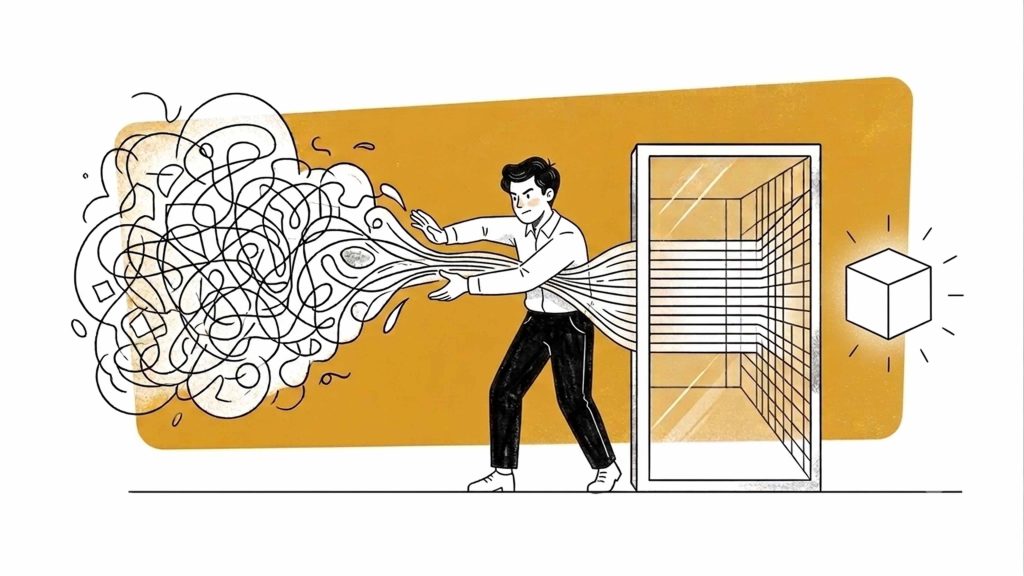
Most ideas do not fail because they are bad.
They fail because they stay too foggy for too long.
A founder has a sense of an opportunity. A team sees a market gap. An investor hears something interesting. A company wants to launch a new product, studio, platform, or service line. The energy is real, but the shape is missing.
People start describing the idea from different angles. One person talks about the product. Another talks about the audience. Another talks about revenue. Another talks about the brand. Another talks about technology. None of them are necessarily wrong. The problem is that the idea has not yet become a venture.
A buildable venture needs more than excitement. It needs enough structure for decisions to begin.
The first task is to separate signal from fantasy
Early-stage ideas attract fantasy.
Fantasy does not always look foolish. Sometimes it looks like ambition, market size, a clean pitch, or a beautiful prototype. The team imagines the product at maturity before it has defined the first version. It talks about scale before it has found a narrow point of entry. It describes the future brand before it knows why anyone would switch.
This is normal. Early ideas need imagination. But imagination has to be disciplined.
The first task is to identify what is actually known.
What problem has been observed?
Who feels it strongly?
What are they doing now instead?
What would make them change behavior?
What evidence exists beyond the founder’s conviction?
What part of the idea is real, and what part is still a story?
This is not meant to kill the idea. It protects the idea from becoming too vague to build.
Define the problem in market language
Founders often describe the problem in internal language.
“We need a better platform for independent operators.” “We want to create a smarter system for business growth.” “We are building a new ecosystem for creators.” These phrases may sound interesting, but they rarely show the buyer’s pain.
A venture becomes sharper when the problem is described in the language of the person who has it.
A restaurant owner does not wake up thinking, “I need an integrated growth ecosystem.” They think, “We are busy on weekends but empty on weekdays.” A founder does not think, “I need narrative architecture.” They think, “People don’t understand what we do, and every investor meeting starts with confusion.” A team does not think, “We need interface optimization.” They think, “Customers keep asking support where to find basic things.”
Market language is grounded in the buyer’s actual situation.
Once the problem is named clearly, the idea becomes easier to test. If the problem cannot be described without abstract language, the venture is not ready.
Choose the first customer, not the total market
The total market is useful for investors. It is dangerous for builders.
Large markets make ideas feel safer than they are. A team says the opportunity is huge because many people could use the product. But “could use” is not a market. A market begins when a specific group has enough pain, urgency, budget, trust, and access to make adoption possible.
The first customer should be narrow.
Not because the venture must stay small, but because early traction needs density. A narrow customer helps the team understand the situation deeply. The product gets sharper. The message becomes less generic. Sales conversations become more useful. The team can see patterns instead of collecting scattered feedback from everyone.
A buildable venture needs a first field of play.
Who is the first serious user or buyer?
What situation puts them in need?
Why would they care now?
What would they compare this with?
What proof would reduce their hesitation?
Without this choice, the venture will try to speak to everyone and sound ordinary to all of them.
Shape the offer before building the product
Many teams move from idea to product too quickly.
They define features, screens, workflows, and technical requirements before they have clarified the offer. The product becomes a pile of imagined capabilities. It may be impressive, but the buyer still cannot answer the basic question: “What do I get, and why should I care?”
The offer sits between the problem and the product.
It explains the value in a form the market can understand. It defines the promise, the outcome, the scope, the proof, the price logic, and the reason to act. A strong offer can make a simple product feel necessary. A weak offer can make a strong product feel optional.
Before building, the team should be able to say:
This is for this kind of customer.
They are struggling with this situation.
We help them move from this state to that state.
The first version includes these things and excludes these others.
The reason to choose us is this.
That sentence may change later. But if no one can write it now, the build will absorb the confusion.
Make the first version smaller than the ambition
A venture needs ambition, but the first version should be disciplined.
The first version is not a miniature version of the final vision. It is a tool for learning whether the core belief is true. It should test the riskiest assumption with the least unnecessary complexity.
This is where teams often struggle. They fear that a smaller version will make the idea look less serious. So they add more features, more audiences, more use cases, more design, more content, more future-facing language. The venture becomes heavier before it becomes clearer.
A smaller first version is not a lack of ambition. It is respect for reality.
What must be true for this venture to work?
What is the smallest version that can test that truth?
What can be manual at first?
What can be removed without damaging the core value?
What would prove that the market wants this enough?
These questions save time. They also protect the team from building a product around assumptions that should have been tested earlier.
Build the venture model, not only the interface
A venture is not a screen.
It includes the product, but also the business model, customer path, operating logic, brand position, delivery system, acquisition motion, and future options. A beautiful interface can hide a weak venture model for a while. It cannot repair it.
Before execution, the team should map how the venture actually works.
How does the customer discover it?
What do they need to understand before trusting it?
How does the product deliver value?
Where does revenue come from?
What does the team need to operate reliably?
What must be automated, and what should stay human?
What does success look like in the first 90 days?
The answers do not need to be perfect. They need to be coherent. A venture can survive uncertainty. It cannot survive every part pulling in a different direction.
The moment an idea becomes buildable
An idea becomes buildable when the team can make decisions without reopening the entire concept every time.
The audience is clear enough to write for.
The problem is clear enough to test.
The offer is clear enough to sell.
The first version is clear enough to design.
The model is clear enough to plan.
The story is clear enough to repeat.
That is the shift from idea to venture.
The work is not to make the idea sound bigger. The work is to give it enough shape that the next move becomes obvious.