
Many companies approach AI as if the main question is which tool to use.
Should we build an agent? Should we use ChatGPT Enterprise? Should we connect our knowledge base? Should we automate support? Should we generate content? Should we add AI to the product? Should we train the team? Should we hire someone?
These are useful questions, but they are not the first questions.
The first question is whether the business is ready to use AI in a way that improves work rather than adding a new layer of confusion.
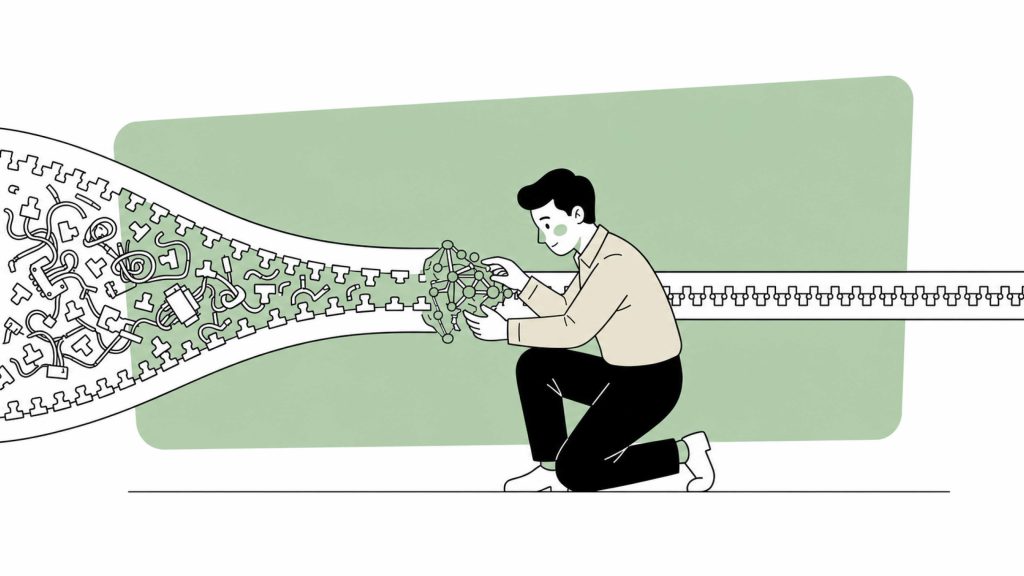
AI can accelerate good systems. It can also accelerate messy ones. If the data is scattered, processes are unclear, ownership is weak, and the team does not know what decisions AI should support, automation will not create intelligence. It will create faster noise.
AI readiness starts with work, not tools
A company should begin by looking at actual work.
Where does time disappear?
Which tasks repeat every week?
Where do people copy information from one place to another?
Which decisions require searching through old documents, chats, emails, or spreadsheets?
Where do customers ask the same questions?
Where does quality depend too much on one person’s memory?
Where does the team produce the same kind of content, report, analysis, brief, proposal, or support response again and again?
These are better starting points than tool comparisons.
AI becomes useful when it is attached to a real workflow. Without that connection, it becomes a novelty. People test prompts, generate drafts, summarize documents, and feel impressed for a week. Then usage drops because the tool has not been embedded into the way work actually happens.
Readiness means identifying where AI belongs inside the operating system of the business.
Data quality is not a technical detail
AI projects often fail because the knowledge base is not ready.
Documents are outdated. Files are duplicated. Naming conventions are inconsistent. Important context lives in Slack, personal notes, email threads, or someone’s head. Sales materials say one thing, delivery documents say another, and the website says something else. The company wants an AI assistant to answer questions, but the source material is not trustworthy.
The assistant cannot solve that alone.
A retrieval system can find information. It cannot decide which version of the company is true. A model can generate answers. It cannot repair contradictory strategy, outdated policies, unclear product logic, or missing documentation without human judgment.
Before building AI on top of company knowledge, the business should ask:
Which sources are authoritative?
What is outdated?
Who owns the knowledge?
How should sensitive information be handled?
What should the system never answer from memory?
Where does human review remain necessary?
This work is not glamorous. It is the foundation.
Automation needs process clarity
If a process is unclear, AI will expose the confusion.
Take customer support. If refund rules are inconsistent, tone varies by agent, escalation paths are informal, and product information changes without documentation, an AI support layer may increase inconsistency rather than reduce it.
Take sales. If the company has no clear qualification criteria, no stable offer language, and no defined follow-up logic, AI-generated outreach may simply produce more messages that sound efficient but sell badly.
Take content. If the brand has no point of view, no audience choice, and no editorial standard, AI will produce more average content faster.
The issue is not AI quality alone. The issue is process quality.
Automation should follow a defined path. What triggers the workflow? What information does it use? What output should be produced? Who reviews it? What happens when the system is uncertain? What should be logged? What should never be automated?
Without these decisions, AI becomes an improvised assistant inside an improvised company.
Security and trust cannot be added at the end
AI introduces new questions about data, access, privacy, compliance, and accountability.
Who can upload what?
Which systems can the AI access?
Can customer data be used in prompts?
Where are outputs stored?
What happens if the model produces a wrong answer?
Which actions require human approval?
How are sensitive documents separated from general knowledge?
Who is responsible when an automated workflow affects a customer?
These questions should not appear after the prototype is already in use.
For small teams, this may sound heavy. It does not need to become bureaucracy. But even a lightweight AI setup needs rules. People need to know what is safe, what is restricted, and where judgment is required.
Trust is part of adoption. If people are unsure whether they are allowed to use a system, they will either avoid it or use it carelessly. Both are bad outcomes.
The human role should be designed deliberately
AI readiness does not mean replacing every human step.
The better question is: Which parts of the work should be done by AI, and which parts still require human judgment?
AI is strong at drafting, summarizing, classifying, extracting, comparing, structuring, searching, and generating variations. Humans remain essential for taste, context, ethical judgment, final responsibility, strategic choice, emotional nuance, and deciding whether the output is actually good.
This division should be explicit.
In many businesses, AI adoption fails because the role is vague. People do not know whether the tool is a helper, a reviewer, a writer, an analyst, a support layer, or an operator. They either overtrust it or underuse it.
A useful AI workflow defines the handoff.
The system drafts. The human approves.
The system searches. The human judges relevance.
The system flags patterns. The team decides what to change.
The system handles routine questions. Humans handle exceptions.
This is how AI becomes operational instead of theatrical.
Start with one workflow that matters
A company does not need a grand AI transformation plan to begin.
It needs one useful workflow with clear value, clear data, clear ownership, and clear risk boundaries.
For example:
A proposal assistant that pulls approved case studies, offer language, and pricing logic into a first draft.
A sales call summarizer that extracts objections, next steps, and CRM updates.
A support assistant trained on current product documentation and escalation rules.
A knowledge search system that helps the team find internal answers without asking three people.
A content production workflow where AI prepares research, structure, and draft options, while humans own the point of view and final edit.
The first workflow should be valuable enough that people care, but contained enough that the business can learn safely.
Readiness is a business discipline
AI readiness is not only a technical audit. It is a business discipline.
It asks whether the company understands its own work well enough to improve it with machines. It asks whether knowledge is organized. It asks whether decisions are clear. It asks whether the team has standards. It asks whether risk is understood. It asks whether the business can tell the difference between speed and usefulness.
AI can help a business become more capable. But it will not automatically make the business wiser.
Before automating, fix what the automation will depend on.
The best AI projects usually begin with a plain observation: “This part of the business is repetitive, valuable, and currently messy. Let’s make it clear enough for AI to help.”