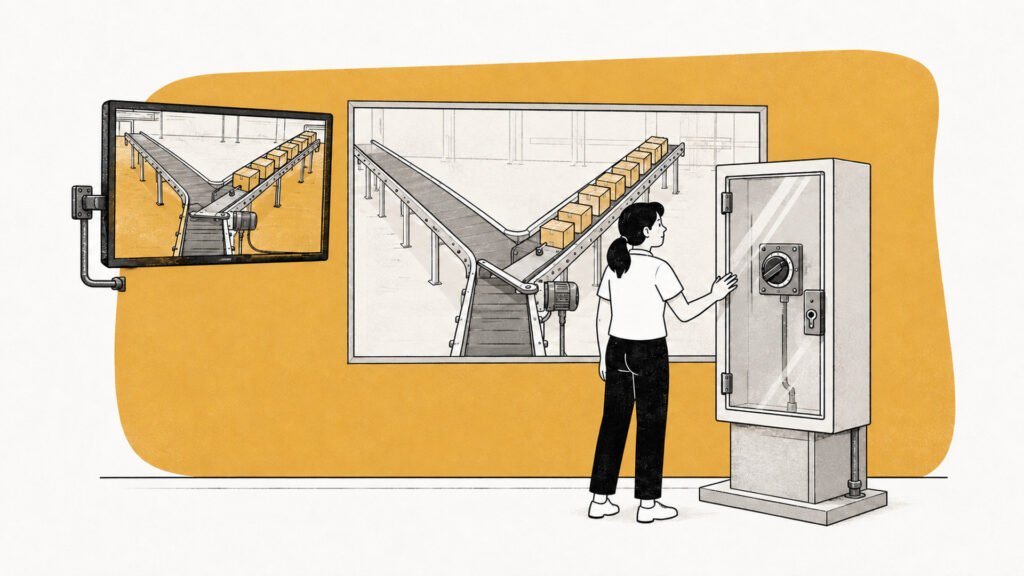
An operations dashboard turns red at 8:07 in the morning.
The regional team sees the problem immediately. Demand has shifted, inventory is moving toward the wrong locations, and a service commitment will be missed unless the plan changes.
The team cannot change it.
Finance has to approve the cost. Operations owns the target but not the inventory rule. The system owner can alter the workflow but cannot accept the commercial risk. By noon, the dashboard has appeared in three meetings and two executive messages. The decision arrives the next day.
The company has real-time data attached to a previous-generation authority system.
Digital transformation often improves how quickly information is captured, connected, and displayed. That matters. But the time between seeing a problem and changing the business depends on more than data. It depends on who can interpret the signal, who has permission to act, which thresholds trigger a response, and who carries the consequence.
When those questions remain unresolved, technology moves data faster than decisions.
Visibility can hide decision latency
Transformation programs tend to make visible progress first.
Systems are connected. Manual reports become dashboards. Teams gain access to current numbers. Alerts replace periodic reviews. Leadership can see more of the operation without waiting for information to travel through several layers.
This feels like a faster company because the problem becomes visible sooner.
Then the old operating model takes over. The local team prepares an explanation. A manager asks for another cut of the data. Two functions disagree about which metric should govern the response. The issue moves upward because the person accountable for the outcome does not control the resources needed to change it.
The delay no longer sits in information retrieval. It sits between information and authority.
That distinction matters because reporting latency is easy to measure. Decision latency is distributed across waiting, clarification, approval, escalation, and repeated interpretation. Each step may look reasonable on its own. Together, they can absorb the time the digital system was supposed to save.
Better dashboards improve a different part of the problem
The argument is not that dashboards are cosmetic.
Information quality affects judgment. An experiment involving 524 participants found that the format, currency, and completeness of dashboard information influenced decision quality indirectly by changing perceived task complexity and information satisfaction. Clearer information can make a difficult choice easier to understand.
It cannot decide who is allowed to make that choice.
A dashboard can show that customer churn is rising without resolving whether product, service, sales, or finance owns the response. It can show a margin problem without deciding whether a regional manager can change a price. It can show a capacity risk without giving the operating team authority to move people or postpone lower-value work.
In fact, better visibility can increase organizational traffic. More people see the same signal, each function requests the analysis it trusts, and the volume of commentary grows. The business becomes better informed and no more decisive.
The problem is sometimes misdiagnosed as resistance to data. Often the data is accepted. The unresolved issue is what the data authorizes anyone to do.
Decision rights are part of digital design
Decision rights are a plain idea: who has the authority to make a decision and who is accountable for its result.
They are often treated as a governance document created after the technology has been selected. That sequence leaves an essential part of the product undefined.
MIT’s Center for Information Systems Research describes digital governance through the allocation of decision rights and accountabilities. The value of the definition is that it moves governance away from committees and policies in the abstract. It asks who can decide the matters that determine whether a technology investment creates value.
Consider a digital pricing system. The interface can recommend a price, show demand, calculate margin, and flag unusual movement. The operating design still has to answer practical questions. Can a local team accept a lower margin to protect a strategic relationship? Which decisions require finance review? When does a recommendation become an action? Who can override the model, and how is that override examined later?
Without those answers, the tool produces advice inside a vacuum. People either wait for approval or invent informal authority around the system.
Both outcomes weaken control. One creates delay. The other hides who is actually making the decision.
Central control and fast decisions are not opposites
The obvious response is to push every decision closer to the work. That can be reckless.
Some choices affect regulatory exposure, security, shared infrastructure, brand promises, capital allocation, or several business units at once. Local context does not remove enterprise consequence. A fast decision can still be a bad decision.
The useful distinction is between centralizing guardrails and centralizing every move.
An organization can define risk limits, shared metrics, architecture standards, and escalation thresholds centrally. Within those boundaries, teams can act without asking permission each time. A reversible pricing adjustment under a defined limit can happen locally. A change that creates contractual or regulatory exposure moves to the right owner. The boundary is designed before the urgent moment arrives.
Empirical research suggests that digital transformation and authority structures do move together. A Journal of Business Research study using 15,358 firm-year observations found digital transformation associated with less centralized decision rights in Chinese business groups. A later study in hospitality and tourism groups also found digital transformation associated with greater decentralization, with uncertainty and organizational distance shaping the effect.
These studies do not prove that decentralization is always better or that the same structure fits every company. They make a narrower point useful: digital transformation changes the conditions under which authority is allocated. Treating decision rights as fixed while information flows change is unlikely to remain coherent.
More data can become a form of avoidance
Leaders often ask for more evidence because a decision is genuinely uncertain. That is sensible when new information could change the choice.
The same request can also delay ownership.
Another forecast will not resolve a disagreement about acceptable risk. A more detailed customer analysis will not decide which segment the company is willing to disappoint. A new dashboard will not settle whether the local team or headquarters controls the response.
Data becomes a safe place to continue working while avoiding a trade-off.
This is especially common when accountability and authority are separated. A manager can be held responsible for an outcome but lack control over the price, people, product, or policy that shapes it. The rational response is to escalate and document. The organization creates an evidence trail instead of a decision.
A useful review asks what information would materially change the action. If the answer is unclear, the missing input may not be data. It may be a risk appetite, priority, or owner.
Measure the path from signal to action
Most digital programs measure system availability, adoption, data quality, cycle time, and cost. Decision performance deserves the same attention.
How long passes between a signal and an authorized response? How many handoffs occur? Which decisions repeatedly escalate? Where do teams ask for approval despite operating inside an agreed boundary? How often is a decision reversed because the wrong owner made it or because critical context arrived too late?
The answers reveal whether the operating model matches the information architecture.
MIT CISR’s 2025 research defines an enterprise IT operating model through accountabilities, processes, platforms, metrics, and behaviors. That connected view is important. A platform does not sit outside the organization. It changes who knows what, when they know it, and what coordinated action becomes possible.
The transformation design should therefore specify four things alongside the workflow: the owner of the decision, the authority available at each level, the threshold for escalation, and the feedback that shows whether the decision worked.
This does not guarantee speed. Some decisions deserve time. It makes the delay intentional rather than inherited.
A business becomes more responsive when information reaches someone who can do something useful with it. If the dashboard changes but the authority system does not, the company may see tomorrow’s problem in real time and still answer it with yesterday’s organization.